In this story
- The Kona Coffee Belt on the Western Big Island
- Kona Typica, the Region's Signature Variety
- Growing and Harvesting
- Processing Coffee Cherries into Green Coffee
- Hawaiʻi Green Coffee Grades
- Kona Coffee's Aroma and Flavor
- The History of Coffee Growing in Kona
- Hawaiʻi Coffee Production and Prices
- Pests, Diseases and Climate Risks
- 100% Kona and Kona Blends Compared
- A Basic 100% Kona Pour-Over Recipe
- 100% Kona Pour-Over at Mahina
Kona coffee is grown on the slopes of Hualālai and Mauna Loa on the western side of the island of Hawaiʻi, also known as the Big Island. Small family farms line the hillsides facing the Pacific. Farmers have long cultivated the region's signature variety, Kona Typica. Known for its rich aroma, gentle acidity and smooth texture, Kona coffee takes on different characteristics according to each farm's growing conditions, processing and roasting.
The Kona Coffee Belt on the Western Big Island
The legally defined origin of Kona coffee is North Kona and South Kona on the island of Hawaiʻi. The growing area along the western slopes where these coffee farms are concentrated is known as the Kona coffee belt.
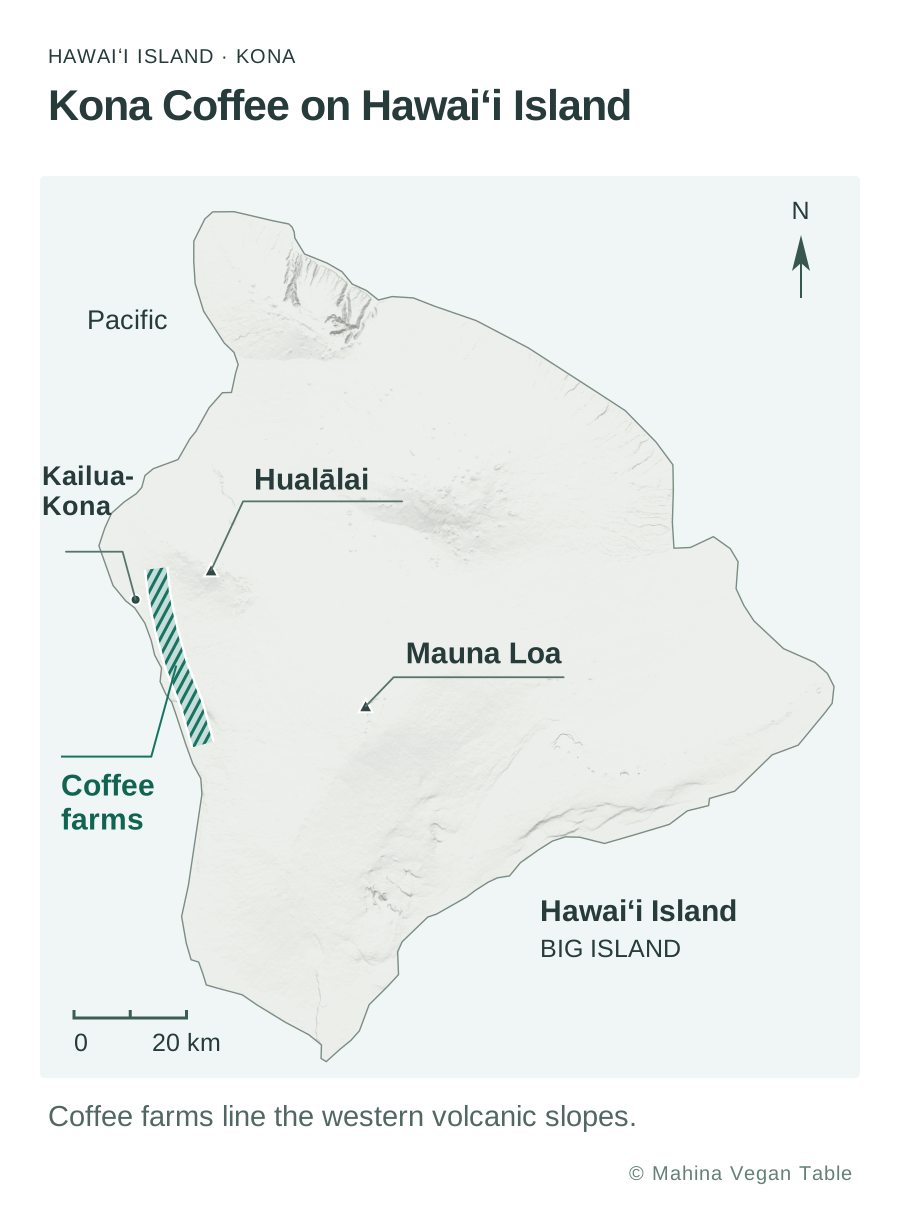
The traditional Kona coffee belt runs roughly 32km parallel to the western coastline and is about 3.2km wide. It extends from Palani Junction in the north to Puʻuhonua Road in the south. Farms are located at elevations of around 150–915m, with the middle slopes historically considered the main growing area generally at about 210–610m. Elevation and slope aspect affect sunlight, rainfall, flowering and the timing of fruit ripening.
Small family-run farms are central to Kona coffee production. Most cover less than approximately 2ha. Even neighboring farms can produce distinctive coffees because of differences in plot location, varieties, harvesting and processing.
Elevation, Temperature and Afternoon Rain
Kona's middle slopes have mild temperatures suitable for arabica. Observation records at elevations of approximately 445–510m showed an annual mean temperature of about 20.6°C, an average minimum of about 15.6°C and an average maximum of about 25.6°C.
Around 1,520–2,160mm of annual rainfall is considered suitable for coffee growing. Its timing also matters. Rainfall aligned with tree growth, flowering and fruit development helps farmers maintain tree health and stable yields.
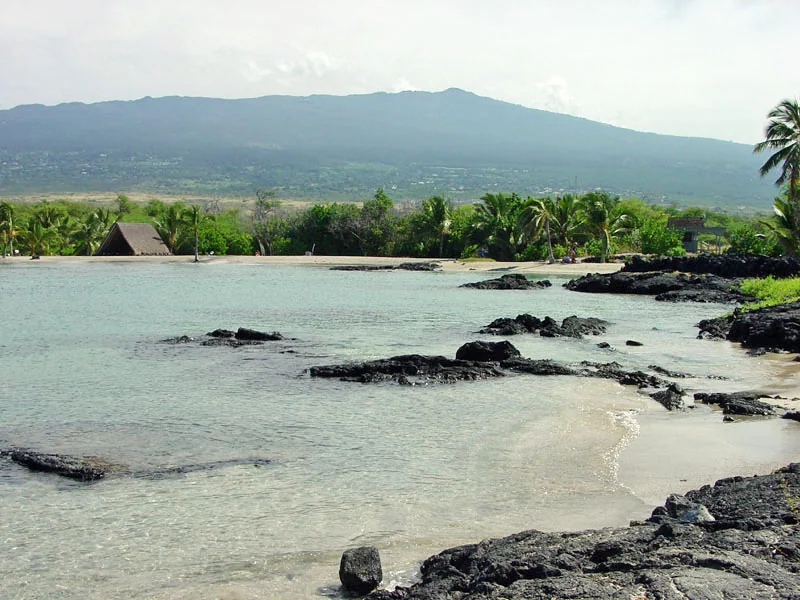
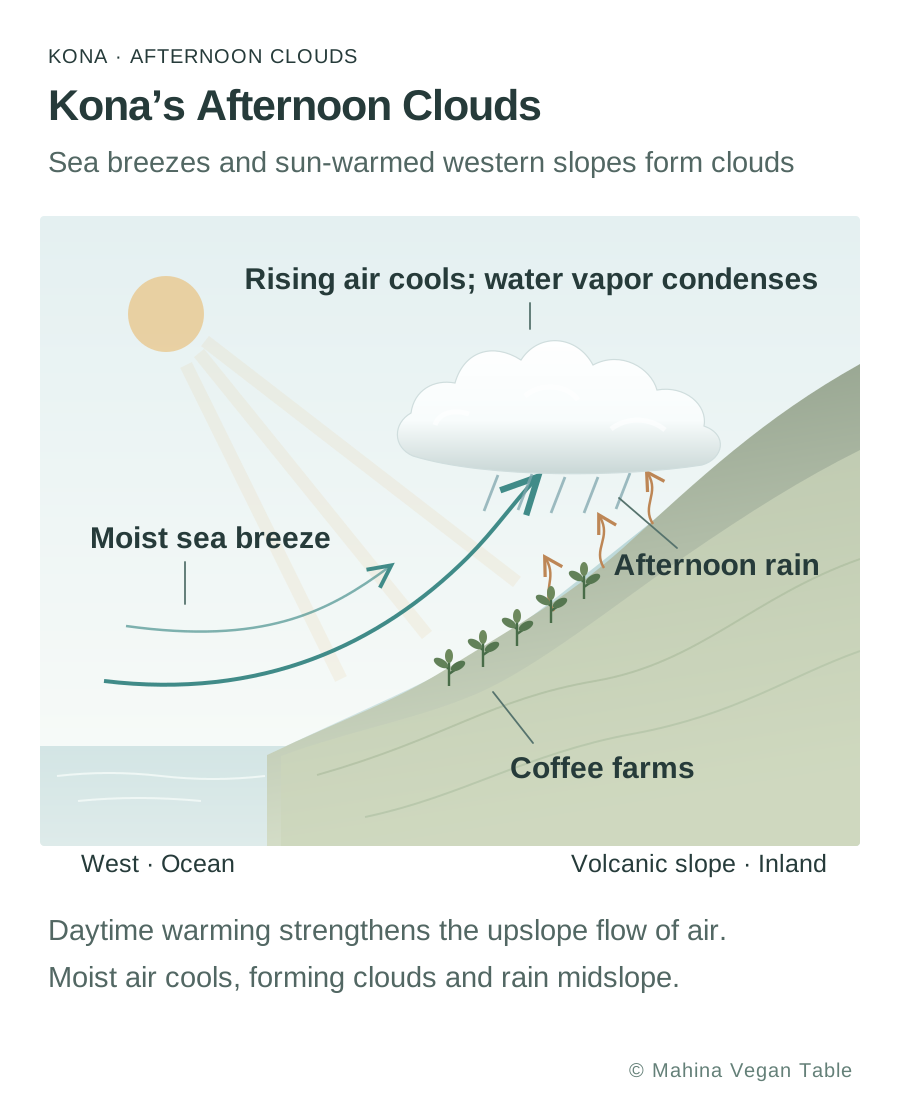
Rain in Kona tends to fall in the afternoon. As the western slopes warm during the day, moist ocean air moves inland and rises along the hillsides. The air cools with elevation, and water vapor condenses to form clouds and rain. The meeting of ocean and volcanic slopes helps shape Kona's daily weather.
Kona Typica, the Region's Signature Variety
Kona Typica belongs to the Typica lineage of arabica (Coffea arabica). The lineage long known in Hawaiʻi as “Guatemalan” is also called Kona Typica. Hermann Widemann introduced it to Hawaiʻi from Guatemala in 1892, and Kona farmers were growing it widely by around 1910.
Alongside Kona Typica, farmers in Kona have grown other varieties, including Red Caturra. “Kona” identifies the geographic origin; “Typica” identifies the variety. Adding the variety and processing method to the origin gives a more precise description of the coffee.
Growing and Harvesting
Coffee trees in Kona flower in several flushes. Their timing and number vary with elevation. Farms at about 370–520m may experience three or more major flowering periods. At higher elevations of around 610–760m, two or three major flushes may occur from February to April, while lower sites may see their main flowering in February and March.
Several flowering flushes mean that cherries on the same tree ripen at different times. Farmers need to make repeated selective harvests, extending both the harvest season and the period of pest and disease management.
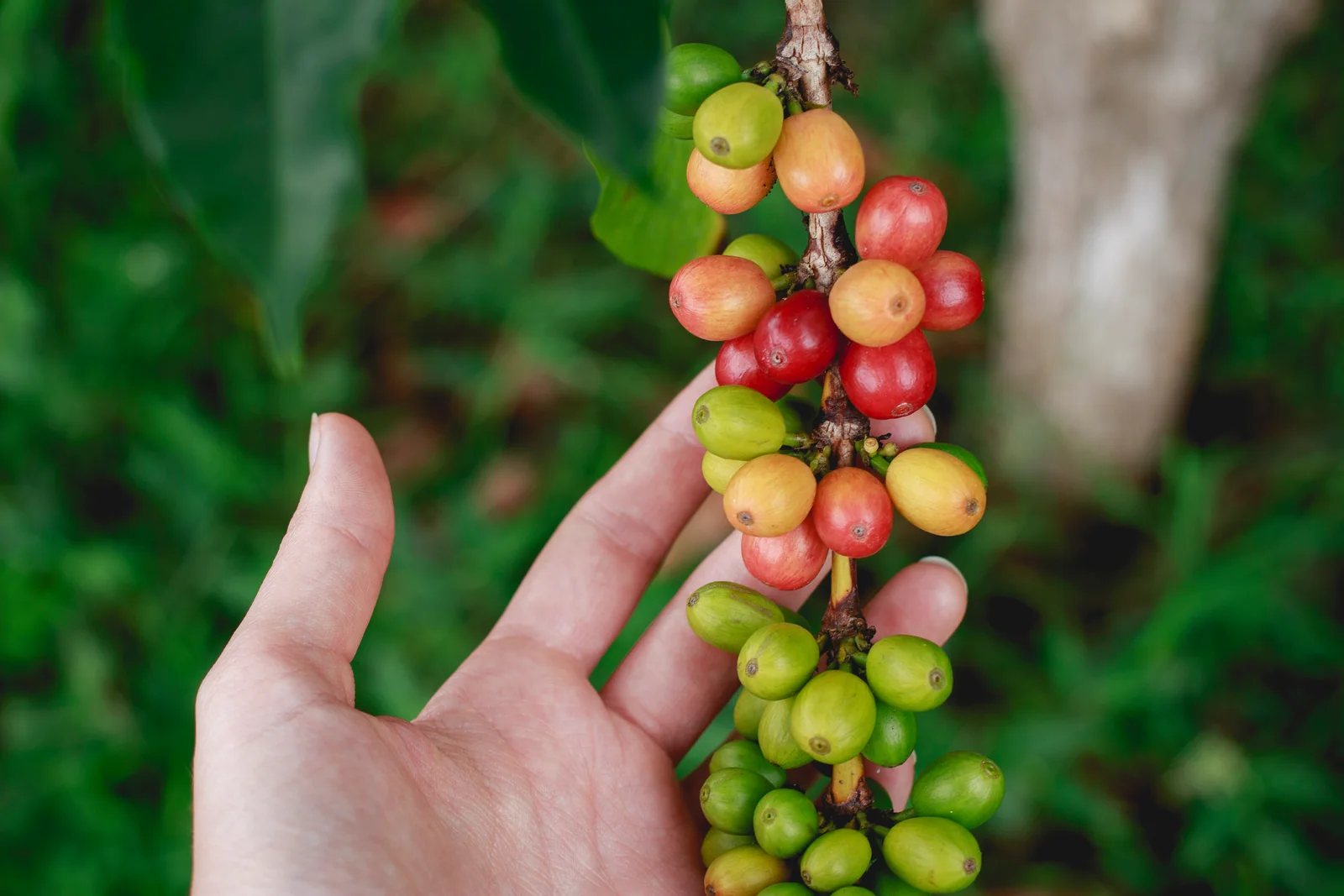
At harvest, farmers select fully ripe cherries and sort out diseased, underripe and overripe fruit. Prompt transport to the processing facility also matters because harvested cherries deteriorate if left piled up for too long. Consistent ripeness and rapid handling after harvest lay the foundation for green coffee quality.
Processing Coffee Cherries into Green Coffee
Green coffee consists of the unroasted seeds obtained after removing the fruit's flesh and coverings. Key distinctions between processing methods are when the flesh is removed and the condition in which the seeds are dried. In addition to traditional wet processing, Kona produces natural, honey-processed and controlled-fermentation coffees.
Wet Processing
Wet processing is also called washed processing. It generally follows this sequence.
- Harvest ripe cherries, then remove foreign material and defective fruit.
- Remove the flesh with a machine called a pulper.
- Remove the sticky mucilage on the surface of the parchment—the firm layer surrounding the seed—through fermentation and washing or by mechanical means.
- Dry the seeds in their parchment until their moisture content has fallen evenly.
- Allow the coffee to rest, then remove the parchment and sort the green beans by size, density and defects.
Wet processing has long been used throughout Hawaiʻi, particularly in Kona. Its defining feature is drying the coffee in parchment after removing the flesh and mucilage. Even mucilage removal during fermentation and washing, followed by consistent moisture reduction during drying, is important.
Dry Processing
Dry processing is also called natural processing. Whole harvested cherries are dried before the dried flesh, parchment and thin silverskin covering the seeds are removed to obtain green coffee. Drying with the flesh attached can create flavors different from washed processing. Kona also produces natural coffees emphasizing fruit aromas and richness. Hawaiʻi's green coffee grading standards include separate provisions for dry-processed coffee.
Honey Processing and Anaerobic Fermentation
Honey processing removes the flesh but leaves mucilage around the seeds during drying. No honey is added; the method uses the sticky layer naturally present in the coffee cherry. How much mucilage remains and how the coffee is dried influence sweetness, texture and aroma development.
Anaerobic fermentation takes place in a vessel with restricted oxygen entry. While honey processing describes how mucilage is handled before drying, anaerobic fermentation describes the fermentation environment. Kona producers also combine the processes, for example by fermenting coffee in a sealed environment before honey drying. Farms manage separate lots according to variety, harvest date and fermentation and drying conditions.
Hawaiʻi Green Coffee Grades
Hawaiʻi authorities grade green coffee by assessing moisture, size, seed form, defect counts and basic roast appearance and flavor characteristics. The main grades are Extra Fancy, Fancy, No. 1, Select and Prime. These standards are used to sort and trade coffee before roasting.
The following table summarizes the principal grades for wet-processed Kona green coffee. All grades require moisture of 9.0–12.2%; defects are measured against a 300g green coffee sample or as a proportion of total weight.
| Grade | Main Defect Allowances | Minimum Size | Additional Criteria |
|---|---|---|---|
| Kona Extra Fancy | No more than 8 full defects per 300g of green coffee | Type I: 19; Type II: 13 | Uniform, good green color; must also meet roast appearance, aroma and flavor requirements |
| Kona Fancy | No more than 12 full defects per 300g of green coffee | Type I: 18; Type II: 12 | Less restrictive size and defect allowances than Extra Fancy |
| Kona No. 1 | No more than 18 full defects per 300g of green coffee | Type I: 16; Type II: 10 | Must also meet color, roast appearance, aroma and flavor requirements |
| Kona Select | Defective beans no more than 5% of total weight, including no more than 2% serious defects | No specified minimum size | Must be free of sour spoilage, fermented, moldy, chemical and similar off-flavors or odors |
| Kona Prime | Defective beans no more than 15% of total weight, including no more than 5% serious defects | No specified minimum size | A higher defect allowance than Select |
Peaberry Shape and Grading
Type I generally consists of two seeds developing in one cherry with their flat sides facing each other. Type II develops as a single rounded seed and is commonly traded as peaberry. The two forms use different size criteria. Extra Fancy, for example, applies separate minimum sizes to Type I and Type II while also assessing moisture and defect allowances.
Kona Coffee's Aroma and Flavor
Kona coffee is typically associated with rich aroma, gentle acidity and a smooth texture. Traditional styles based on Kona Typica emphasize a balance of aroma, acidity and mouthfeel. Farm location, variety, cherry ripeness, processing and roasting then give each coffee its individual character.
How Roasting Changes Flavor
City roast, a medium degree of roasting, is used to bring out a balance of aroma, acidity and texture in Kona coffee. As roasting becomes darker, roast-derived aromas and bitterness become more prominent, while perceived acidity and mouthfeel also change. This is why even green coffee from the same farm can produce different impressions depending on when the roaster ends the roast.
How Processing Changes Flavor
Kona's processing methods have become more diverse. Producers make washed coffee with the flesh and mucilage removed, honey-processed coffee dried with mucilage attached, and natural coffee dried as whole cherries. Kona producers may emphasize sweetness and a rich texture in honey processing, or fruit-like aromas in natural processing. These methods add another layer of aroma to the smooth character traditionally associated with Kona.
Flavor becomes clearer when you consider the aroma before sipping, acidity and sweetness in the first sip, texture in the mouth and the finish after swallowing. Enjoy the rising aroma while the coffee is warm, then take time to explore the balance of sweetness and acidity as it cools slightly.
The History of Coffee Growing in Kona
Don Paulo Marin attempted to grow coffee in Hawaiʻi in 1813 but did not establish it successfully. In 1825, John Wilkinson and Hawaiian High Chief Boki planted coffee in Mānoa. Samuel Ruggles subsequently brought coffee plants from Mānoa to Kona in 1828.
In 1892, Hermann Widemann introduced a Typica lineage from Guatemala. It later became established as Guatemalan, or Kona Typica.
In the early 20th century, the Kona coffee industry grew through the labor of several communities, including Japanese immigrant farmers, and a foundation of small family farms. By around 1920, approximately 80% of Kona coffee farms were small family operations. Farmers used facilities for pulping coffee cherries and drying platforms with movable roofs called hoshidana. The surviving Uchida coffee farm and living-history materials preserve both the family's living spaces and its coffee production facilities.
Farmers formed community support groups called kumi to address difficulties in work and daily life together. They also established credit unions to provide financing and cooperatives to sell coffee. Alongside advances in cultivation, Kona coffee's history is the story of small farms sustaining production and family life.
Hawaiʻi Coffee Production and Prices
The statewide Hawaiʻi coffee forecast for 2025–2026, released on January 23, 2026, included the following figures.
- Bearing acreage: approximately 2,630ha
- Total production: approximately 8,255t of coffee cherries
- Projected marketed volume: approximately 8,094t of coffee cherries
- Average price: approximately $5.14/kg of coffee cherries
- Projected value of marketed production: $41.579 million
Marketed volume was forecast to decline by 20% from the previous season.
These statistics describe production and marketing at the coffee-cherry stage, as harvested on the farm. Cherries lose weight through pulping, drying, hulling and roasting, while sorting and processing costs accumulate at each stage.
Kona coffee production requires managing small sloping plots, repeated selective harvests, pest and disease control, sorting and drying. Hawaiʻi's labor and land costs, together with certification, processing and transport, add to the cost. Limited growing scale and labor-intensive production are important factors behind Kona coffee prices.
Pests, Diseases and Climate Risks
Coffee Berry Borer
The coffee berry borer (CBB), Hypothenemus hampei, is a small insect pest. Females bore into coffee cherries and damage the seeds inside. It was first confirmed in Hawaiʻi in South Kona in August 2010.
Cherries left on trees or the ground can harbor the pest, allowing populations to grow again in the next harvest. Farmers need to combine frequent harvesting, removal of remaining cherries at the end of the season and regular pest monitoring. Combining complementary methods in this way is known as integrated pest management (IPM).
Coffee Leaf Rust
Coffee leaf rust (CLR) is a fungal disease caused by Hemileia vastatrix. After its first confirmation in Hawaiʻi in 2020, it spread to the major islands. Samples collected in Hawaiʻi were identified as race XXIV. This race was found capable of causing disease in several arabica lineages, including Kona Typica.
Farmers need to detect disease early and manage branches and foliage to avoid excessive density. Maintaining tree nutrition, keeping farms clean and using legally permitted control methods are also important. Developing disease-resistant varieties is another priority.
Drought and Changing Weather
Coffee trees tend to flower when rain follows a dry period. Water shortages during fruit development can affect yields and tree health. Coffee leaf rust, coffee berry borer, drought, irregular weather and labor shortages were all cited as contributing to Hawaiʻi's statewide production decline in 2023–2024. Pest and disease control, water management and securing harvest labor are also important challenges for Kona farmers.
100% Kona and Kona Blends Compared
100% Kona Coffee consists entirely of coffee grown in Kona. Kona Coffee Blend combines Kona coffee with beans from other origins. Origin percentages are based on the weight of the green coffee before roasting.
| Label | Bean Origin and Processing |
|---|---|
| 100% Kona Coffee | Coffee made entirely from Kona-grown beans |
| Kona Coffee Blend | Coffee combining Kona beans with other origins. The front label states the Kona content and the weight percentages of the origins. |
| All Hawaiian | Coffee whose beans are all grown and processed in Hawaiʻi. For decaffeinated products, decaffeination must also take place in Hawaiʻi. |
| 100% Arabica | All beans are arabica. Kona identifies a geographic origin; arabica identifies the coffee plant species. |
100% Kona Coffee and All Hawaiian can appear on the same product. A blend of beans from different Hawaiian regions can also qualify as All Hawaiian if all growing and processing take place in Hawaiʻi.
After Contains:, blends list the weight percentages of each origin in descending order, totaling 100%. Under specified conditions, beans from several foreign origins may be grouped as Foreign-grown Coffee. Green coffee used in products bearing Hawaiian regional names must also meet the state's grading requirements.
Minimum Kona Blend Content and Implementation Dates
Hawaiʻi expanded covered products and origin-percentage labeling through Act 211 of 2023, then raised the minimum regional content for blends bearing regional names through Act 198 of 2024. As of September 2026, the implementation schedule is as follows.
| Date | Change |
|---|---|
| Signed July 5, 2023; implementation and enforcement from July 1, 2024 | Act 211 expanded coverage beyond roasted and instant coffee to include prepackaged ready-to-drink coffee beverages and individual brewing packets provided by lodging establishments. Blends must disclose origin percentages by weight on the front label and retain related records. |
| Signed July 3, 2024; legally effective from July 1, 2024 | Act 198 raised the minimum regional coffee content of blends bearing Hawaiian regional names to 51%. The new percentage applies from July 1, 2027. |
| Through June 30, 2027 | Covered blends labeled or advertised with a Hawaiian regional name must contain at least 10% coffee from that region by weight. |
| From July 1, 2027 | The same minimum rises to 51% by weight. |
Under this law, ready-to-drink coffee beverages are products packaged before sale. Beverages prepared after an order is placed are excluded from that definition.
A Basic 100% Kona Pour-Over Recipe
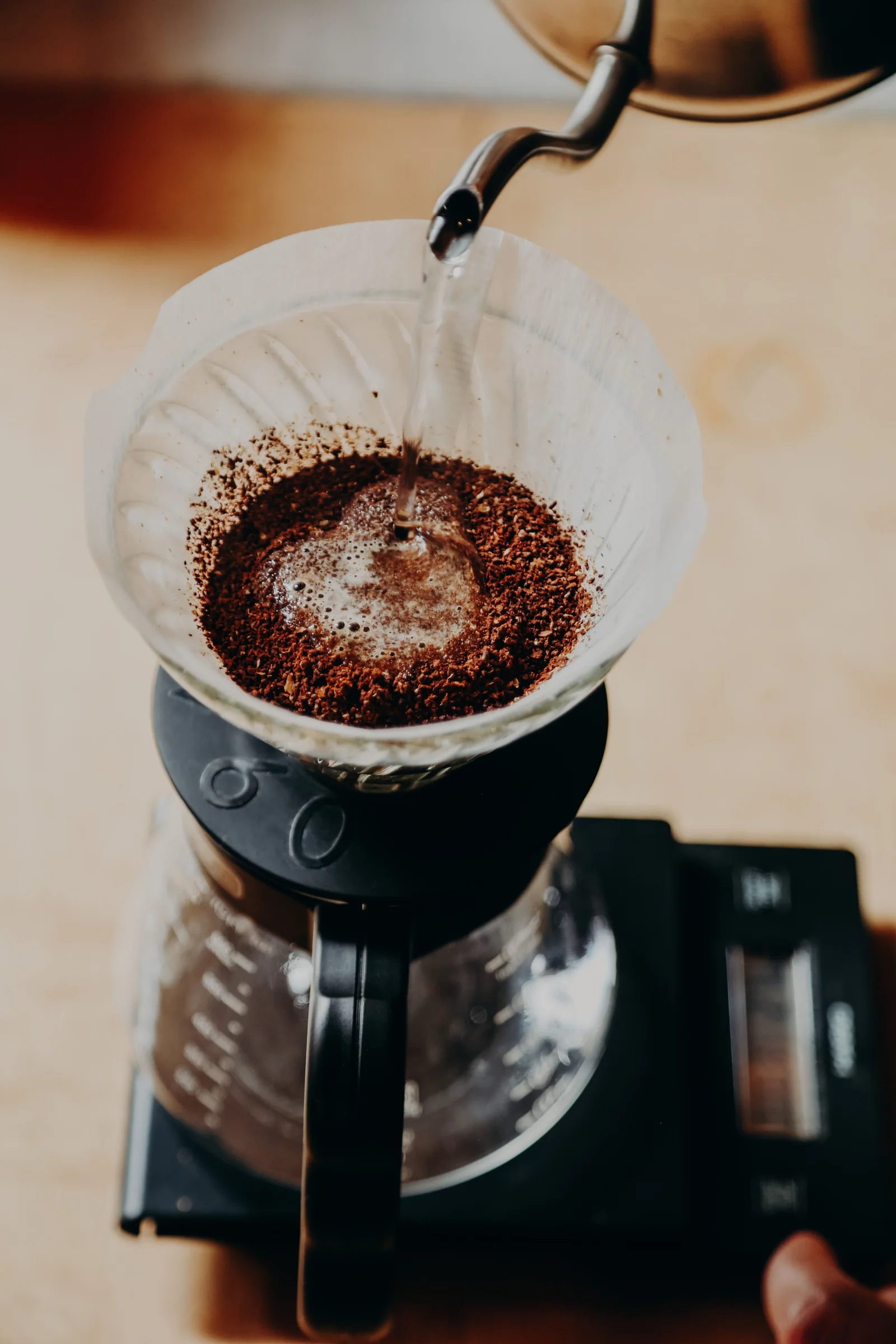
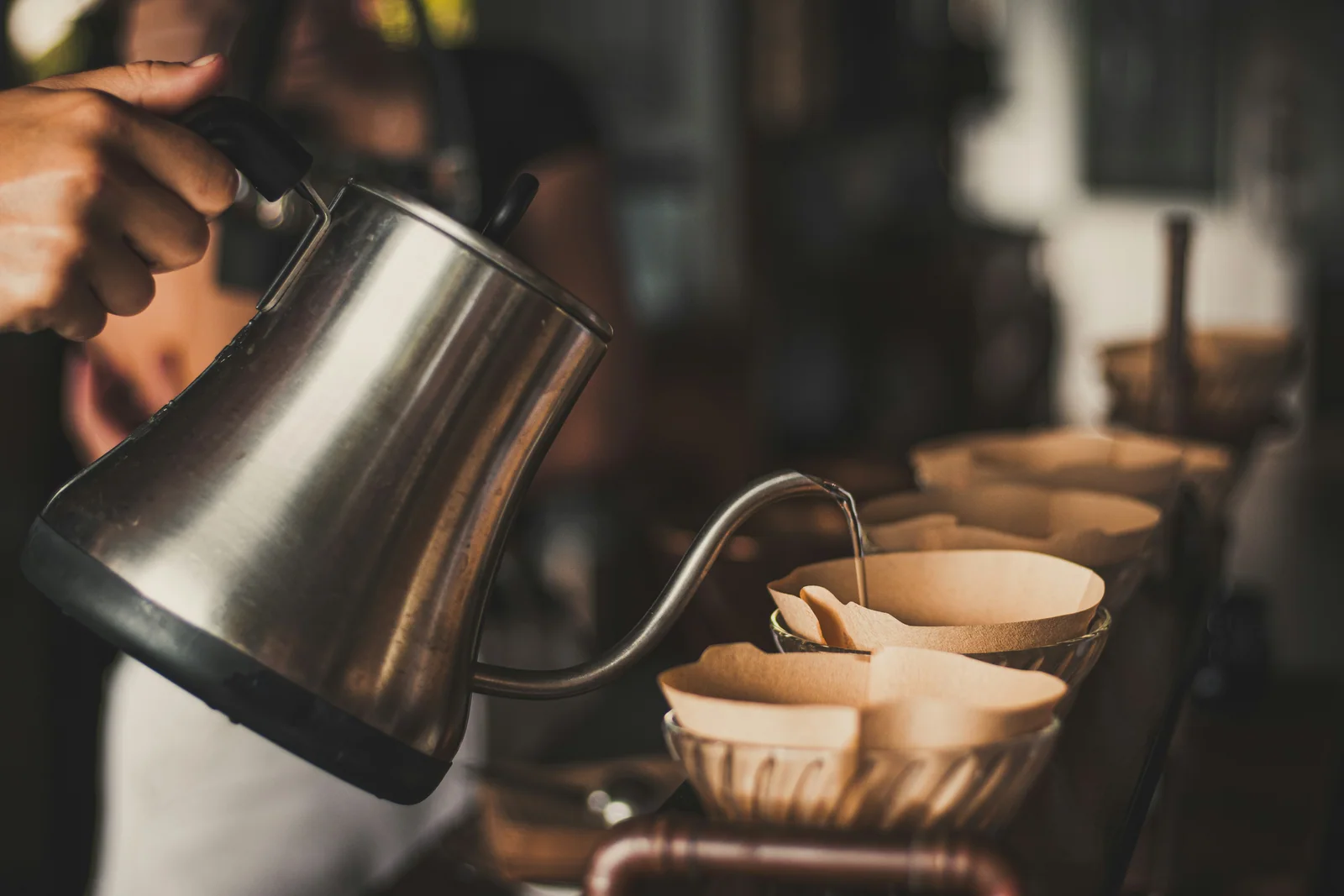
Pour-over brewing offers a leisurely way to enjoy Kona coffee's aroma, acidity and texture. Brew a cup with this recipe, then adjust it to the roast level and your taste.
- Coffee: 15g
- Water: 250g
- Coffee-to-water ratio: approximately 1:17
- Water temperature: 92–94°C
- Grind: medium
- Bloom: add 45g of water and wait 45 seconds
- Main brew: pour in two or three stages until the total water reaches 250g
If a darker roast quickly becomes too bitter, lower the water temperature or grind slightly coarser. If sharp sourness dominates and the aroma seems underdeveloped, grind slightly finer or increase the contact time between coffee and water. Change one variable at a time to make the effect easier to understand.
100% Kona Pour-Over at Mahina
Mahina Vegan Table serves 100% Hawaiian Kona single-origin coffee as a pour-over. Take in the aroma of freshly brewed coffee, then savor it from the warm first sip to the lingering finish as the cup cools slightly. A cup of Kona offers a relaxed way to enjoy the time after your meal.