In this story
- Brew Ratio, Strength and Extraction Yield
- What Happens in the Coffee Bed After Pouring
- How Brewing Variables Affect Extraction
- Pour-Over Equipment
- How Water Hardness and Alkalinity Affect Coffee
- Recording and Adjusting Grind Size
- Temperature Differences Between Kettle and Coffee Bed
- Pouring Technique and Flow Through the Coffee Bed
- Adjusting Strength with Water After Brewing
- Five Pour-Over Recipes
- An Adjustment Sequence for Your Preferred Flavor
- Adjustments Based on Flavor and Drawdown
- Brewing Records for Consistent Flavor
- Safety and Hygiene
- Common Points of Confusion in Pour-Over Brewing
- Enjoying Kona Pour-Over at Mahina
Pour-over is a filtered brewing method in which hot water is poured over ground coffee and passes through it by gravity. Unlike immersion brewing, where all the water and coffee remain together in one vessel, newly poured water travels through the coffee bed, carrying soluble compounds and fine particles downward.
Even with the same beans, the dripper's shape, filter, grind size and water composition can change the flavor. Pouring speed and placement matter too: these conditions alter how long water remains in the coffee bed and how much material dissolves.
Follow a recipe below as written before adjusting it to your taste. Change only one factor at a time—coffee dose, water quantity or composition, water temperature, grind size or pouring technique—to make the reason for a flavor change easier to identify.
Brew Ratio, Strength and Extraction Yield
Coffee-to-Water Ratio
Brew ratio compares the weight of the coffee used with the weight of the water poured. Using 15g of coffee and 250g of water gives a ratio of 1:16.7. A smaller number on the water side generally produces a stronger cup; a larger one produces a lighter cup.
Finished Beverage Weight
Some of the 250g of poured water remains in the wet grounds and filter or evaporates. Weighing the coffee in the server after drawdown gives the finished beverage weight. You need both this weight and the beverage's concentration to calculate how much material was extracted from the grounds.
TDS as a Measure of Beverage Strength
Total dissolved solids (TDS) is the percentage by weight of dissolved solids in coffee. It is measured with a coffee refractometer. A TDS of 1.30% means that 100g of coffee contains approximately 1.30g of dissolved solids. Higher TDS means a stronger beverage, but coffees at the same concentration can taste different depending on the beans, roast and extraction.
Extraction Yield: The Proportion Extracted from the Coffee
Extraction yield is the proportion of the dry coffee's weight that dissolves into the beverage. If 15g of coffee produces 225g of beverage at 1.33% TDS, the extraction yield is 19.95%. Strength describes the concentration in the cup; extraction yield describes how much material was removed from the grounds.
Extraction yield is an average across the entire coffee bed. When channeling concentrates water into particular pathways, frequently wetted areas extract differently from less-wetted areas. This explains why a coffee can taste harsh and lack aroma even when its average extraction yield falls within a suitable range.
What Happens in the Coffee Bed After Pouring
The Bloom: Wetting the Grounds and Releasing Gas
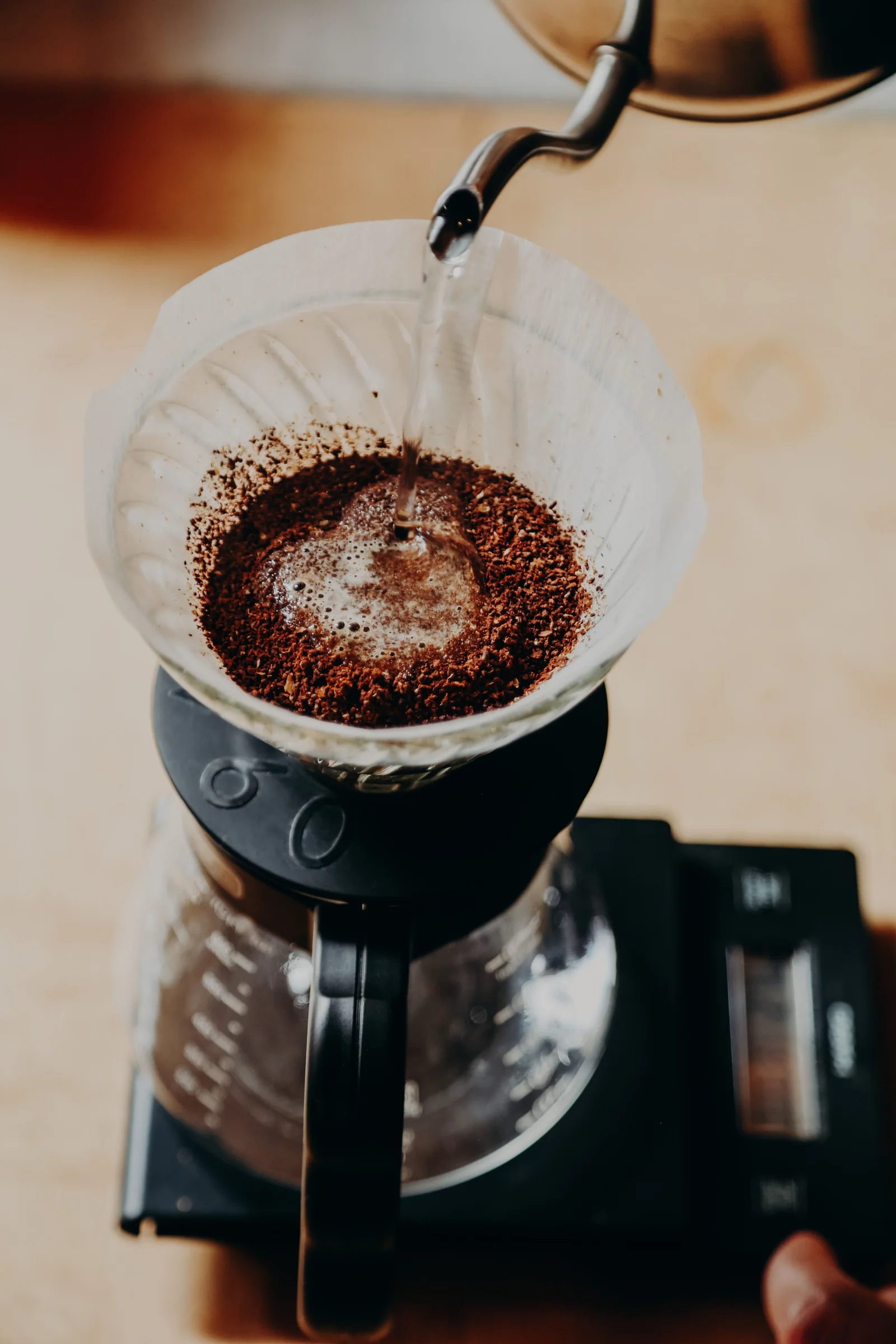
Carbon dioxide formed during roasting gradually escapes from coffee beans. The first pour of hot water releases remaining gas, causing the bed to swell. The initial stage of evenly wetting the coffee with a small amount of water is called the bloom. It reduces large bubbles and dry clumps before the main extraction.
The rate of gas release varies with roast date, roast level, storage, bean moisture and cooling conditions. Adjust the bloom time to the condition of the coffee and the rate at which gas escapes.
Dissolving and Transporting Compounds
Water reaches the surfaces of coffee particles and the spaces between them, carrying soluble compounds outward. The composition of the coffee dripping through early in the brew differs from that of the later fractions. Many flavors and aromas generally decline in intensity as extraction progresses, although sweetness and floral aroma have sometimes been perceived more strongly in later fractions.
Acidic and bitter compounds dissolve during overlapping stages of extraction. Understanding flavor involves considering not only extraction sequence but also the concentration of each fraction and how its compounds interact.
Filtration and Bypass
Paper filters retain coarse particles, many suspended fine particles and oil droplets. Dissolved compounds and some fine particles pass through.
In a broad sense, unintended bypass occurs when water escapes along the filter walls or through structural gaps without passing sufficiently through the coffee bed. By contrast, water may deliberately be added to finished coffee simply to lower its concentration. This post-brew dilution, also called bypass, is used to adjust filter coffee strength independently.
How Brewing Variables Affect Extraction
The table below summarizes common changes when one brewing variable is adjusted.
| Adjustment | Common Changes in the Coffee Bed and Water | Possible Flavor Effects | Related Issues to Watch |
|---|---|---|---|
| Grind Finer | More surface area contacts water and the gaps between particles narrow, potentially accelerating dissolution or retaining water longer. | Strength and extraction yield may increase. | Fines can clog the filter, contributing to channeling and astringency. |
| Grind Coarser | Less surface area contacts water, which may flow faster. | Extraction yield may decrease. | The time difference may be small if the dripper outlet controls the flow. |
| Use More Water | More water is available to dissolve coffee compounds, but the final concentration may fall. | The cup may become lighter while extraction yield increases. | A weak cup can easily be mistaken for an underextracted one. |
| Raise the Water Temperature | Dissolution and diffusion accelerate, and the coffee bed's temperature is easier to maintain. | Extraction yield may increase over the same brewing time. | Temperature alone may have a small effect when final TDS and extraction yield are matched. |
| Increase Agitation | Fresh water contacts more particles, and the particles change position. | Extraction yield may increase. | Fines can migrate downward, clogging the filter or making flow uneven. |
| Raise the Water Level | A higher hydraulic head—the pressure from the water's height—can change flow rate. | Depending on the dripper, extraction may become faster or more intense. | Water escaping through the filter walls and movement in the coffee bed also change. |
| Increase the Number of Pours | Each pour changes agitation, water level, temperature and contact time. | Flavor does not change in one consistent direction. | Other conditions can easily change along with the number of pours. |
| Add Water After Brewing | The dissolved solids remain almost unchanged while beverage weight increases. | Concentration and perceived intensity decrease. | In principle, extraction yield does not change. |
Water temperature affects dissolution rates and water flow. However, when grind size and brewing time are adjusted to match strength and extraction yield, flavor differences between 87°C, 90°C and 93°C may be perceived as small. Record the finished flavor, strength and brewing time rather than considering temperature alone.
Pour-Over Equipment
Basic Tools
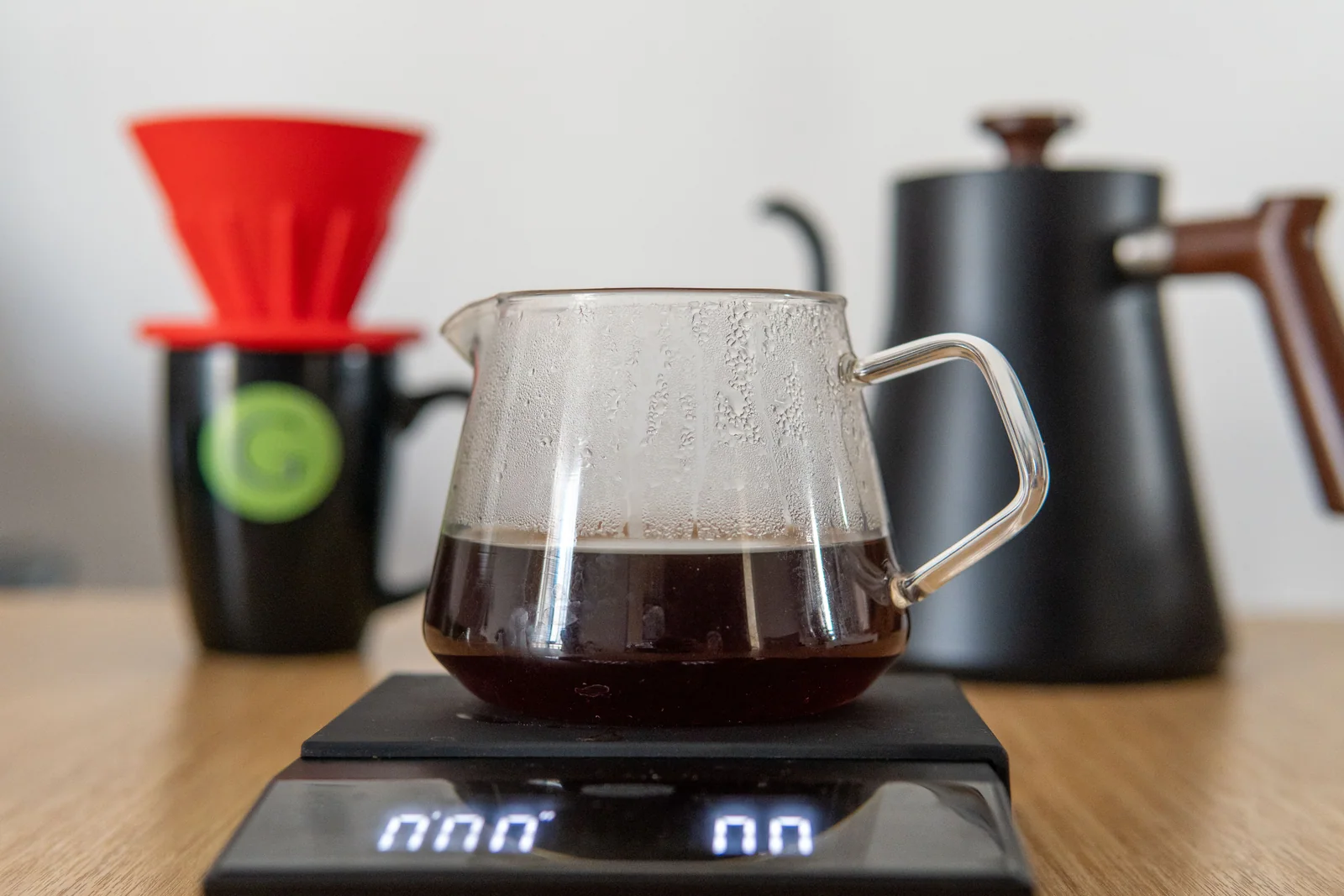
- Scale: Record the actual weights of coffee and water. A scale measuring in 0.1g or 1g increments is sufficient.
- Burr grinder: Crushes beans between two interlocking grinding surfaces. It makes similarly sized particles more consistently than a blade grinder.
- Dripper and compatible filter: The filter's material, thickness, folding method and fit against the dripper affect water flow.
- Kettle: A gooseneck kettle is convenient for producing a fine, steady stream, though it is not essential.
- Timer and server: Record brewing time and finished beverage weight. A scale with a built-in timer also works.
Tools for More Detailed Flavor and Extraction Control
- Thermometer: Check the difference between the kettle's displayed temperature and the actual water temperature.
- Coffee refractometer: Compare TDS and calculate extraction yield. Follow the instrument's instructions for zero calibration, temperature compensation and sample preparation.
- Water hardness and alkalinity tests: An ordinary TDS meter alone cannot identify the types and quantities of ions in the water.
- Grind-size reference samples or photographs: Grinder numbers are not directly comparable across different models, zero points or degrees of burr wear.
Start by becoming comfortable weighing coffee and water and adjusting grind size. A refractometer becomes useful when you want to examine perceived flavor differences more closely through strength and extraction yield.
How Water Hardness and Alkalinity Affect Coffee
Brewing water influences aroma and acidity. Even waters with similar total mineral content can produce different coffee flavors if their calcium, magnesium and alkalinity differ.
- TDS: An estimate of the total amount of dissolved material in water. It does not identify the substances present.
- Hardness: Mainly related to calcium and magnesium levels. It can affect the dissolution of coffee compounds and the amount of scale deposited in equipment.
- Alkalinity: The capacity to neutralize acid and resist changes in pH. Higher alkalinity can make coffee's acidity less distinct.
- pH: Indicates how acidic or basic the water is at that moment. It is different from alkalinity.
- Chlorine and unpleasant odors: These can directly interfere with coffee aroma and are best removed.
The effects of positively charged dissolved ions such as calcium and magnesium on coffee extraction have not converged on a single explanation. Chemical calculations indicate that both ions can bind to certain coffee compounds. By contrast, experiments examining individual coffee compounds found that extraction of the organic acids studied was not strongly determined by calcium and magnesium composition. Other, less-soluble compounds or interactions among perceived flavors may also play a role.
When reviewing water composition, it is more useful to compare hardness, alkalinity and the taste of the brewed coffee together than to focus on one mineral.
A Comparison Test That Changes Only the Water
Brew two cups with the same coffee and recipe, changing only the water. For bottled water, note the product name and any hardness or mineral information on the label. Keep water temperature, grind size and pouring technique the same. Taste without knowing which water was used, comparing the cups from hot to cool. Decide whether to change your usual water after repeated tests show the same difference.
Recording and Adjusting Grind Size
Setting 20 on one grinder does not mean the same grind size as setting 20 on another. Even on the same grinder, particle size and uniformity vary with the zero point where the burrs touch, burr alignment and wear, rotational speed, bean density and roast level.
Recording the grinder model, setting and brewing time makes the next cup easier to adjust. The very small particles produced during grinding are called fines. Their quantity also affects drawdown.
Adjust grind size in the following order.
- Keep the coffee-to-water ratio, water temperature and pouring technique unchanged.
- If the coffee is sharply sour, lacks aroma and drains too quickly, grind one step finer.
- If it has drying astringency and harsh bitterness, with an excessively long drawdown, grind one step coarser.
- If brewing takes a long time but the flavor is still flat, fines may have clogged the filter or channeling may have occurred. Before grinding finer, check for excessive agitation and examine how the filter fits the dripper.
Consider particle size and drawdown together when adjusting the grind. If fines cause water to pool or follow narrow channels, a finer grind will not necessarily produce even extraction.
Temperature Differences Between Kettle and Coffee Bed
During manual pouring, the kettle's displayed temperature differs from the actual coffee-bed temperature. Water loses heat according to kettle material, room temperature, dripper material, preheating and pouring speed.
Try adjusting water temperature within these ranges according to roast level.
- Light to medium roasts: 92–96°C
- Medium to dark roasts: 88–93°C
- Very dark, readily soluble roasts: begin testing at 85–90°C
Changing water temperature can also alter flow rate and total brewing time. After a temperature adjustment, note how flavor and drawdown change together.
Pouring Technique and Flow Through the Coffee Bed
Bloom Water and Time
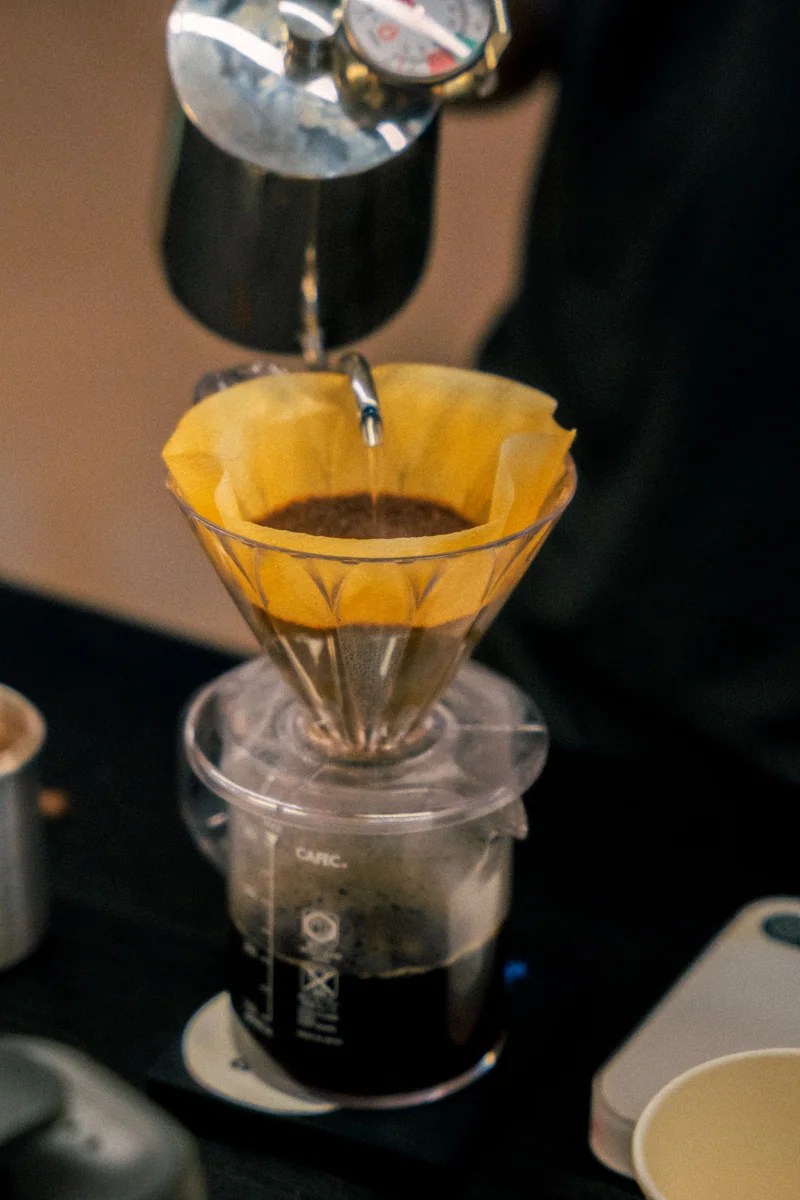
Try blooming with about 2.5–3.5 times the coffee's weight in water. For 15g of coffee, that is approximately 38–53g of water.
Wait 40–60 seconds. If dry clumps remain, wet them with a brief, gentle swirl of the dripper or a stir with a spoon. Excessive agitation can move fines down toward the filter and obstruct the subsequent flow.
Pouring Height and Flow Rate
The stream moves and mixes the coffee particles it strikes. Pour volume and height can therefore influence agitation and the dissolution of compounds.
A suitable pouring height depends on the dripper and coffee. Start by practicing a consistent height and flow rate without splashing or breaking the stream.
Water Level and Pulse Pouring
- A higher water level increases pressure from the water column, but may also increase water escaping through the filter walls.
- Dividing the water into more pours increases agitation while also changing water level, temperature and total brewing time.
- During a continuous pour, avoid concentrating the stream only in the center.
Even with the same number of pours, different pour volumes and pauses can change the result. Specifying both cumulative water weights and pouring times, as in the recipes below, makes brewing more repeatable.
Adjusting Strength with Water After Brewing
Adding water after brewing makes the beverage lighter and gentler while leaving the amount extracted from the grounds almost unchanged. Adding approximately 35g of water to 180g of coffee at 1.55% TDS lowers the concentration to about 1.30%. Add water in 5–10g increments, mixing and tasting each time, rather than pouring in a large amount at once.
Five Pour-Over Recipes
Start the timer at 0:00 when you begin pouring. The table's Expected finish time runs from the first pour until the stream beneath the dripper has almost stopped. If the finish time falls outside the expected range, taste the coffee before adjusting grind size. 150g cumulative means that the total water poured by that point is 150g.
1. A Basic Recipe for a Conical Dripper
| Variable | Setting |
|---|---|
| Coffee | 15g |
| Water | 250g |
| Ratio | Approximately 1:17 |
| Temperature | 93°C |
| Grind | Slightly finer than medium |
| Bloom | 0:00–0:45, 45g |
| First Pour | 0:45–1:10, 150g cumulative |
| Second Pour | 1:20–1:45, 250g cumulative |
| Expected Finish Time | Approximately 2:30–3:30 |
Rinse the filter thoroughly, warm the server and discard the rinse water. Level the grounds, pour 45g evenly and give the dripper one gentle swirl. During the two main pours, move between the center and the surrounding area without pouring directly onto the filter walls. Finish with one gentle swirl to level the bed.
2. Two Cups with a Flat-Bottom Dripper
| Variable | Setting |
|---|---|
| Coffee | 20g |
| Water | 320g |
| Ratio | 1:16 |
| Temperature | 92°C |
| Bloom | 0:00–0:45, 60g |
| First Pour | 0:45–1:05, 160g cumulative |
| Second Pour | 1:20–1:40, 240g cumulative |
| Third Pour | 1:55–2:15, 320g cumulative |
| Expected Finish Time | Approximately 3:00–4:15 |
Wet all the grounds evenly during the bloom, then distribute water across the broad coffee bed. Follow the times and cumulative weights in the table rather than waiting for all the water from each stage to drain. Adjust grind size according to the finished flavor.
3. A Small Cup with a Lower Coffee Dose
| Variable | Setting |
|---|---|
| Coffee | 12g |
| Water | 200g |
| Ratio | Approximately 1:17 |
| Temperature | 93°C |
| Bloom | 0:00–0:40, 36g |
| Main Brew | 0:40–1:25, pour continuously to 200g cumulative |
| Expected Finish Time | Approximately 2:00–3:00 |
A smaller dose creates a shallower coffee bed, so water may drain faster at the same grind size. If the coffee tastes weak and sharp, try grinding slightly finer.
4. A Bypass Recipe with Post-Brew Dilution
| Variable | Setting |
|---|---|
| Coffee | 18g |
| Brewing Water | 240g |
| Water Added After Brewing | 60g |
| Total Water Used | 300g, approximately 1:17 |
| Temperature | 93°C |
| Bloom | 54g, 45 seconds |
| Main Brew | Pour in two stages to cumulative weights of 150g and 240g |
| After Brewing | Add 60g of water and mix well |
Pass 240g of water through 18g of coffee, then add 60g of water after brewing. This separates the amount of water passing through the bed from the strength of the finished drink. The table's 300g is the total water used for extraction and dilution; the final beverage weighs less because some water remains in the grounds and filter.
5. Iced Pour-Over Brewed onto Ice
| Variable | Setting |
|---|---|
| Coffee | 20g |
| Hot Water | 200g |
| Ice in the Server | 120g |
| Total Water and Ice | 320g, 1:16 |
| Temperature | 94°C |
| Bloom | 0:00–0:45, 60g |
| First Pour | 0:45–1:10, 130g cumulative |
| Second Pour | 1:20–1:45, 200g cumulative |
Because you use less hot water than usual, grind slightly finer to extract sufficiently. Once drawdown is complete, stir the server to melt the ice and equalize temperature and concentration.
An Adjustment Sequence for Your Preferred Flavor
In the coffee industry, adjusting brewing conditions to suit the beans and equipment is called dialing in. Changing one variable at a time makes it easier to identify what changed the flavor.
- When opening a new coffee, brew the first cup with your established baseline recipe.
- Let it cool to a comfortable drinking temperature, then compare its aroma and flavor while warm and lukewarm.
- First judge the strength in your mouth. If it is too strong, change the coffee-to-water ratio or add bypass water. If it is too weak, reduce the water quantity.
- Once the strength is right, assess extraction. If the coffee is sharply sour and flat, choose just one adjustment: a finer grind, higher water temperature or longer contact time.
- If it feels drying and tastes harsh, choose just one adjustment: a coarser grind, lower water temperature or less agitation.
- Brew again with the adjusted recipe to check whether it reliably produces the flavor you want.
Adjustments Based on Flavor and Drawdown
| Problem | Possible Causes | First Adjustment | What to Check Next |
|---|---|---|---|
| Sharp Sourness and a Short Finish | Low extraction yield, low water temperature or excessively fast flow | Grind one step finer | Water temperature and how evenly the grounds are wetted during the bloom |
| Bitterness and Drying Astringency | Excessive extraction in some areas, fines clogging the filter or excessive agitation | Grind one step coarser | Reduce the number of pours and swirls |
| Strong, Sour and Harsh | High concentration combined with uneven extraction within the bed | Check bed evenness and pouring technique before adding more water | The final bed shape and water bypassing along the filter walls |
| Weak but Bitter | Low concentration may coincide with harsh late-stage extraction | Use less water and a slightly coarser grind | Measure TDS and extraction yield separately if possible |
| Drawdown Suddenly Slows | More fines, a clogged filter or excessive agitation | Grind slightly coarser or reduce agitation | Grinder cleanliness and the filter's product name and production date |
| Water Drains Too Quickly | A coarse grind, cracks in the bed or a poorly fitted filter | Grind slightly finer | Pour placement and the bloom |
| Inconsistent Results Between Brews | Inconsistent weights, water temperature, pour volumes, flow rates or stage timings | Use a scale to match cumulative water weights | Practice pouring consistent amounts from the kettle |
| A Muddy or Rough Mouthfeel After Cooling | Fines, excessive extraction in some areas or the roast profile | Reduce agitation and grind slightly coarser | Compare water properties and the coffee's inherent flavor |
Interpret brewing time alongside flavor. Suitable times change with the dripper, dose, filter and grind size. Use the record to investigate when a brew takes substantially longer or shorter than usual.
Brewing Records for Consistent Flavor
What to Record
- Coffee name, production lot and roast date
- Dripper and filter product names and sizes
- Coffee weight, total water quantity and the water used or its quality information
- Kettle temperature setting and measured water temperature
- Grinder model, setting and zero-point reference
- Pour start and finish times, with cumulative water weights at each stage
- Number of swirls or stirs
- Time until drawdown is almost complete and finished beverage weight
- TDS and calculated extraction yield, if using a refractometer
- Aroma and flavor while hot and after cooling
Keeping Several Cups Consistent
Brew several cups with the same recipe and compare beverage weights and brewing times. If those figures are similar but the flavor differs, examine pour placement, agitation and the grind. Weight and time help identify where the brewing process changed; make the final judgment by comparing the actual taste as well.
Safety and Hygiene
- Hot water can cause severe burns. Place the dripper and server on a stable, level surface, away from children and electrical cords.
- Avoid sudden, large temperature changes in glass servers and follow the manufacturer's temperature limits.
- Discard filter-rinsing water and water that has been standing for a long time. Wash the server and dripper after each use and dry them completely.
- Do not clean the grinder's outlet or burrs with your fingers. Unplug it and follow the manufacturer's cleaning instructions.
- Do not use homemade mineral concentrates without food-grade ingredients, an accurate scale and verified calculations. Incorrect preparation can create drinking-safety or equipment-corrosion problems.
Common Points of Confusion in Pour-Over Brewing
Hand Drip and Pour-Over
In Korea, filter coffee made by manually pouring water is called hand drip or pour-over. Pour-over describes the act of pouring from above: water passes through the coffee bed by gravity, through a filter and into a server or cup.
The Strength of 1:15 and 1:17 Brews
With other conditions unchanged, 1:15 generally produces a stronger cup because it uses less water. However, actual beverage concentration depends on extraction yield and the water retained by the grounds and filter. The input ratio alone cannot determine TDS.
Boiling Water and Burnt Flavor
Already-roasted coffee does not burn again simply because it touches water at 100°C. Higher water temperatures can change dissolution rates and flavor balance, and the water cools as it travels from kettle to bed. Burnt flavors can have several causes, including a dark roast, excessive extraction in some areas, old coffee oils or dirty equipment.
Bloom Time for Different Coffees
The bloom does not have to last exactly 30 seconds. Roast date, roast level, grind size and dose affect the speed of gas release and wetting. Use 40–60 seconds as a starting point, record the results and adjust.
What to Check When Drawdown Is Too Slow
First check whether you swirled or stirred the coffee bed excessively. Consider whether a forceful pour from high above moved fines downward, how the filter fits the dripper and whether the grinder is producing more fines than usual. Adjust grind size after checking these factors.
High TDS and Overextraction
High TDS does not necessarily mean overextraction. TDS measures beverage concentration; extraction yield measures the proportion of material dissolved from the grounds. Using less water with an appropriate extraction can produce high TDS alongside a suitable extraction yield.
The Role of Post-Brew Bypass
Adding water after brewing can bring coffee to a pleasant drinking strength while leaving extraction yield almost unchanged. Recording the amount added makes the same result easier to repeat.
Enjoying Kona Pour-Over at Mahina
Mahina continues to serve 100% Hawaiian Kona single-origin coffee as a pour-over. Explore its aroma and texture in the first warm sip, then compare how sweetness and acidity change as it cools slightly.