In this story
- A practical starting point for vegan dining in Seoul
- The first clue is the restaurant’s standard, not the dish name
- Ask about the broth before examining the vegetables
- Treat kimchi as a recipe, not simply as a vegetable
- Check what surrounds the tofu
- Inspect bibimbap and gimbap before they are mixed or sliced
- State the full boundary once instead of making a series of partial requests
- When you would rather choose a flavour than investigate a recipe
- A quick memory check at the table
- Turning the checklist into a meal in Garosu-gil
- Questions vegan travellers often ask about Seoul
The short answer
When choosing vegan food in Seoul, look once beyond the visible vegetables to the broth, seasoning and garnish. Meat or fish stock, fish sauce or salted seafood in kimchi, salted shrimp in tofu dishes, and meat or egg in bibimbap and gimbap are all details worth checking. If you would rather shorten that conversation, another option is a restaurant that applies one plant-based standard across its entire menu.
What to remember in Seoul
- A vegetable or tofu main ingredient does not establish that the finished dish is vegan.
- Check broth in soups, fish sauce or salted seafood in kimchi, and salted shrimp in tofu dishes.
- Eggs are animal-derived food; removing an egg does not resolve a meat garnish, seasoning or side soup.
- Mahina prepares every item—not only selected options—as 100% plant-based.
- Vegan status, allergen content and cross-contact are separate questions.
Into the story
A practical starting point for vegan dining in Seoul
A bubbling tofu stew, a bibimbap bright with seasoned greens and a dish of red kimchi can be some of the most inviting sights on a Seoul table. Yet the ingredients you see and the recipe that created the finished dish do not always tell the same story. Broth and seasoning often sit out of sight beneath the flavour. Think of the seven checks below not as a warning list, but as a compact travel tool for enjoying Korean food with more confidence.
The first clue is the restaurant’s standard, not the dish name
Vegetarian, plant-based and vegan do not always communicate exactly the same boundary in every place. Even a dish called vegetable bibimbap, tofu stew or vegetable gimbap may follow a separate recipe for its broth, seasoning or garnish. Find out first whether the restaurant can modify a few dishes or applies a plant-based standard across the whole menu. That one distinction can make every later question shorter.
A vegan diet excludes animal-derived foods including meat, fish, dairy, eggs and honey. Egg is therefore simply one animal-derived ingredient to check, rather than a separate debate. Removing it, however, does not tell you whether a pre-made broth or sauce is vegan.
Ask about the broth before examining the vegetables
A bowl may show only mushrooms, tofu and greens while its flavour base comes from meat or fish. Traditional stews, soups and porridges can also contain meat or seafood, so ask about the broth rather than relying on the visible ingredients alone.
“No meat, please” may not answer the question of stock prepared before service. In a soup or stew, asking about the broth first is usually the quickest route to a clear answer.
A sentence to show the staff 이 음식의 육수에 고기, 생선, 멸치 또는 해산물이 들어가나요? 저는 동물성 재료를 먹지 않습니다. Does the broth contain meat, fish, anchovy or seafood? I do not eat animal-derived ingredients.
Naming anchovy separately can help when the word “meat” is interpreted more narrowly than you intended.
Treat kimchi as a recipe, not simply as a vegetable
Cabbage and radish are plant ingredients. That does not tell you how a particular kimchi was seasoned. KTO explains that kimchi seasoning often contains salted seafood, fish sauce or meat broth, and that some regional recipes use ingredients such as abalone, fish or pork. The practical conclusion is not that every kimchi is non-vegan. Vegan kimchi exists. The conclusion is that each kimchi recipe needs to be checked.
If you enjoy kimchi, it is usually better to ask once than to rule it out automatically:
이 김치는 액젓, 새우젓, 생선, 고기 육수 없이 만들었나요? Was this kimchi made without fish sauce, salted shrimp, fish or meat broth?
If the kimchi recipe cannot be confirmed, you can set it aside and check the sauce or broth in the main dish separately. One side dish cannot answer for the whole meal.
Check what surrounds the tofu
Tofu is plant-based; a finished tofu dish is a separate question. KTO specifically notes that dishes such as soft-tofu stew and braised tofu may use salted shrimp for flavour. The tofu is visually prominent, which can make the less visible seasoning easier to overlook.
The more clearly tofu appears to be the star, the easier it is to overlook everything around it. A useful order is tofu → seasoning → broth → garnish. Asking whether the complete dish contains salted shrimp, fish sauce, meat broth or fish broth gives staff a recipe to verify rather than an ingredient category to interpret.
Inspect bibimbap and gimbap before they are mixed or sliced
Bibimbap may arrive with several seasoned vegetables yet also include meat and an egg. Gimbap may contain ham, egg, tuna or imitation crab. These are examples listed in the KTO’s menu-specific guidance.
For bibimbap, ask before mixing; for gimbap, ask before ordering. Along with meat and egg, check the seasoning on the vegetables and rice and any soup served on the side. If an established recipe cannot be changed, choosing another dish is often more comfortable for both traveller and kitchen than negotiating after it has been assembled.
State the full boundary once instead of making a series of partial requests
When language is a concern, one complete sentence is more useful than a succession of “without this” requests. KTO recommends preparing a clear Korean phrase in advance or using a translator.
A sentence to save on your phone 저는 비건입니다. 고기, 생선과 해산물, 유제품, 달걀, 꿀을 먹지 않습니다. 육수나 양념에 액젓, 새우젓 등 동물성 재료가 들어가지 않았는지 확인해 주세요. I am vegan. I do not eat meat, fish or seafood, dairy, eggs or honey. Please check that the broth and seasonings contain no animal-derived ingredients such as fish sauce or salted shrimp.
If you have an allergy, add the exact allergen separately. Kitchens also differ in what they can change, so asking which dishes already fit your needs is usually more natural than assuming a substitution will be possible.
When you would rather choose a flavour than investigate a recipe
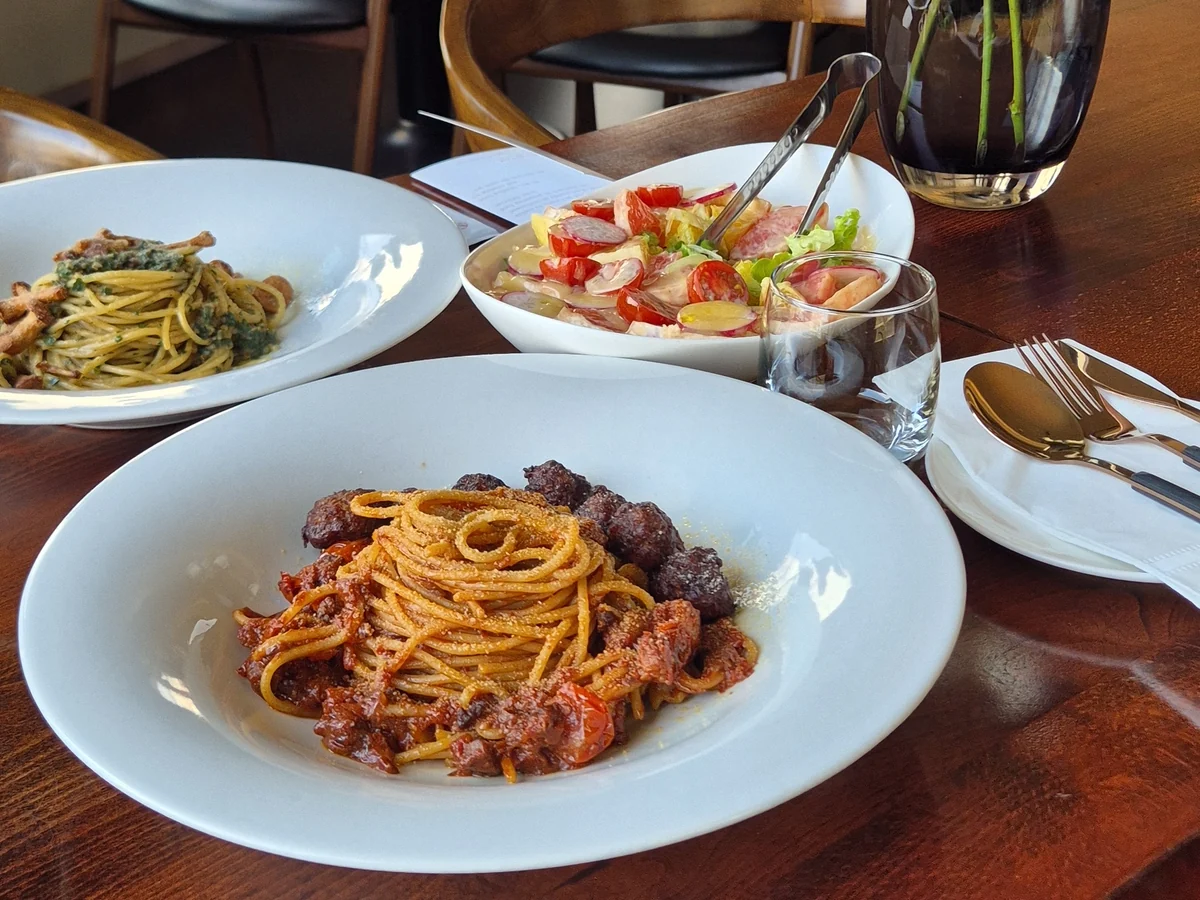
These seven checks are useful, but few travellers want to spend every meal playing culinary detective. For one meal, it is pleasant to begin with “pasta or burger?” rather than “what is in the stock?” Mahina Vegan Table prepares every item—not only selected options—as 100% plant-based. A single standard across the menu changes the order of the questions and leaves more room for choosing by appetite.
At Mahina, 100% plant-based describes the menu-wide standard for animal-derived ingredients. Allergens, possible cross-contact and personally important ingredients such as nuts or gluten still need their own conversation. Menu descriptions focus on the main ingredients and dishes follow established recipes, so naming an ingredient you must avoid before ordering makes it easier to identify a suitable choice.
A quick memory check at the table
| What to check | Why it needs checking |
|---|---|
| Broth in soups, stews and noodles | Meat or fish broth may form the flavour base |
| Kimchi seasoning | Fish sauce, salted seafood or meat broth may be used |
| Seasoning in tofu dishes | Salted shrimp may be used in soft-tofu stew or braised tofu |
| Garnishes and fillings in bibimbap or gimbap | Meat, egg, ham, tuna or imitation crab may be present |
| Mahina’s menu-wide standard | Every item is prepared as 100% plant-based |
| Mahina’s current visit details | The address, hours and booking paths can be checked before visiting |
Turning the checklist into a meal in Garosu-gil
Mahina Vegan Table is on the second floor of 75 Nonhyeon-ro 175-gil, Gangnam-gu, Seoul. It is open Monday through Saturday and closed on Sunday. Lunch runs from 12:00–16:30 and dinner from 17:00–21:00, with a separate last-order time for each service. For reservations made in Korea, use Naver Booking or CatchTable; for reservations from overseas, use CatchTable International. Before visiting, check the official visit page for current hours and reservation availability.
A good travel meal is not necessarily one with no questions; it is one where the necessary questions are settled before the food arrives. At Mahina, the menu-wide 100% plant-based standard removes the need to re-investigate meat stock, fish sauce and animal-derived garnish dish by dish. Once any personal allergy or dietary restriction has been discussed, there is more time at the table for flavour, conversation and the reason you came to Seoul in the first place.

Questions vegan travellers often ask about Seoul
- Is all kimchi in Seoul non-vegan?
- No. Vegan kimchi exists, but fish sauce, salted seafood or meat broth may be used in a particular recipe, so verify that kimchi rather than inferring from the cabbage or radish.
- Is bibimbap vegan if I ask for no egg?
- Egg is animal-derived food, but removing it may still leave a meat garnish, seasoned vegetables or a side soup that needs checking.
- If I say no meat, will that exclude fish and anchovy broth?
- Do not assume it will. Name meat, fish, seafood and anchovy broth separately and ask about fish sauce and salted shrimp where relevant.
- Does a 100% plant-based restaurant automatically make a meal allergy-safe?
- No. Vegan status, allergen content and cross-contact are different questions. Name the exact allergen before ordering.
- Can I visit Mahina without a reservation?
- You may visit without a reservation. At busy times, however, the restaurant may be full and walk-in guests may need to wait; window seats are assigned to guests with reservations first. Reservations are recommended on public holidays, anniversaries, and other days likely to be busy or especially important to you. You can still wait and dine without one, but if you would like a window seat, booking in advance is the better choice. Check availability through Naver Booking or CatchTable in Korea, or CatchTable International from overseas.
Browse the current menu at your own pace, then check the day’s hours and the booking route that works for your card.
View Mahina’s menu