In this story
- Dill is an annual herb with finely divided leaves
- It resembles fennel, but it is not the same plant
- Dill ether is central to the aroma of fresh leaves
- Carvone and limonene are prominent in the seeds
- With fresh dill, look first for changes in aroma
- Dill in the Cucumber Roll of the Autumn Special Course and Autumn Lunch Course
- Common questions about dill
The short answer
Dill is the annual plant Anethum graveolens in the Apiaceae family. Alpha-phellandrene and dill ether make important contributions to the aroma of its fresh leaves and stems, while carvone and limonene tend to be more prominent in the seeds. In the cucumber roll served in the Autumn Special Course and Autumn Lunch Course, parsley, dill, red radish sprouts and edible flowers are arranged together.
Three clues for understanding dill's aroma
- Dill is Anethum graveolens in the Apiaceae family, a plant distinct from fennel.
- Fresh leaves and seeds differ in the proportions of their principal volatile compounds.
- A fresh herb may retain its appearance longer than it retains a full aroma.
Into the story
Dill is an annual herb with finely divided leaves
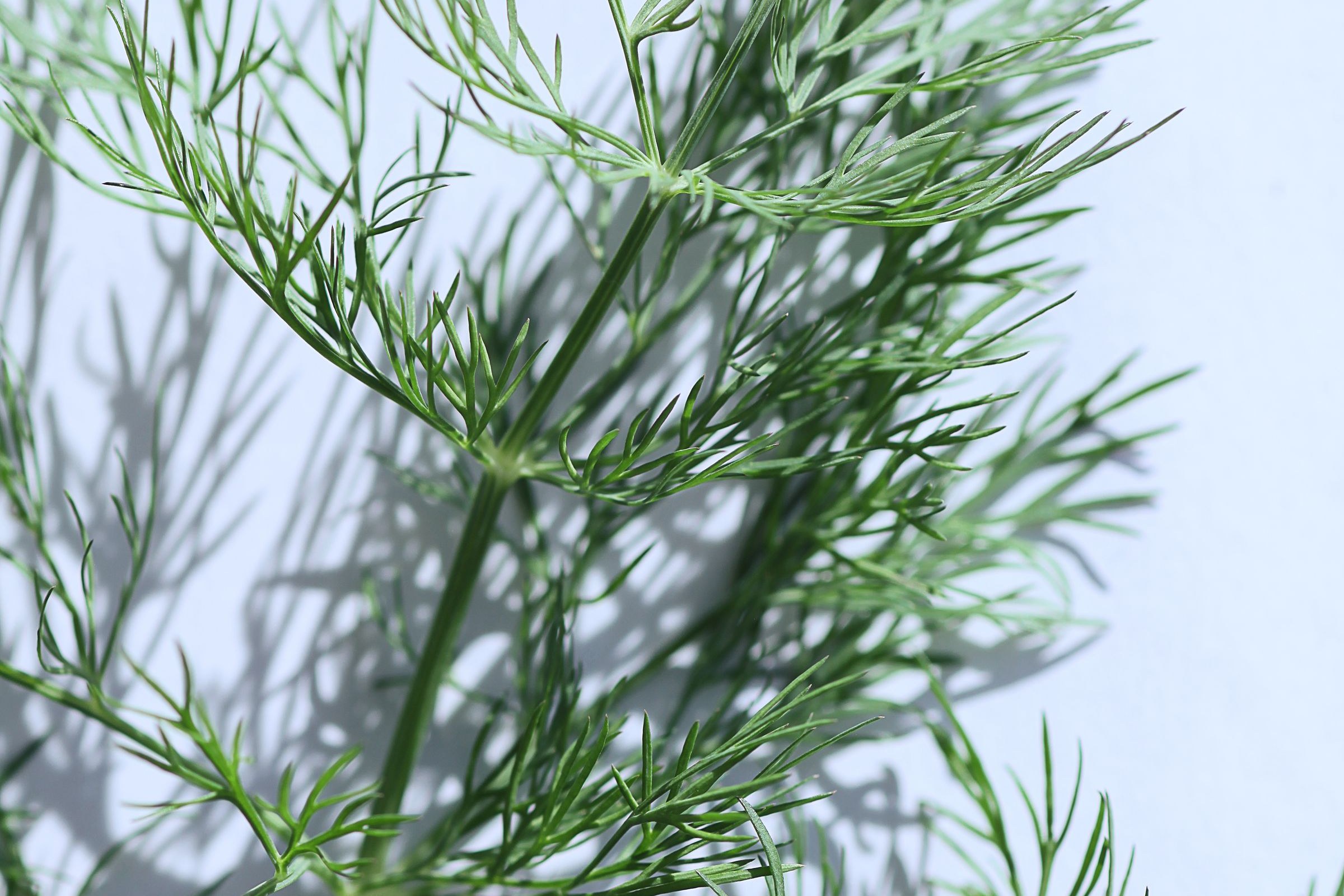
Dill's scientific name is Anethum graveolens, and it belongs to the Apiaceae family. It has finely divided blue-green leaves, hollow stems and umbels of small yellow flowers.
After flowering, the plant forms flat, oval fruits commonly called dill seeds in cooking. The fresh leaves and mature fruits differ not only in form, but also in the compounds central to their aromas.
It resembles fennel, but it is not the same plant
Dill and fennel both belong to the Apiaceae family and have thread-like divided leaves and umbrella-shaped flower clusters. Dill is generally smaller and annual, and can be distinguished by its flat fruit with wing-like margins and its distinctly different aroma.
Fennel's anise-like aroma and dill's green herbal character cannot be treated as interchangeable merely because their leaves look similar. Considering both plant form and aroma compounds makes the difference between the two herbs clearer.
Dill ether is central to the aroma of fresh leaves
Dill ether and alpha-phellandrene are major aroma compounds in dill. Dill ether plays an important part in the plant's distinctive aroma, which recalls both herbs and spices.
The proportions of compounds may also differ between leaves and stems. Stems can contain a higher proportion of dill ether and a lower proportion of alpha-phellandrene than leaves.
Carvone and limonene are prominent in the seeds
Carvone and limonene account for a large proportion of dill-seed essential oil. Their relative amounts can nevertheless vary with growing location, genetic background and light conditions.
Leaf and seed do not simply present stronger or weaker versions of one dill aroma. Their principal compounds differ: fresh leaves tend towards a green herbal character, while the seeds show a more concentrated, spice-like aroma.
With fresh dill, look first for changes in aroma
Dill is a fresh herb harvested for its tender leaves and stems. Essential oils and characteristic aromas can diminish during storage, so the period in which a herb looks saleable may be longer than the period in which it retains ample aroma.
Even while the leaves remain vivid green, their aroma may already have weakened. This is why colour and wilting should be considered together with the characteristic fragrance of the leaves when choosing dill.
Dill in the Cucumber Roll of the Autumn Special Course and Autumn Lunch Course
The first appetizer in both the Autumn Special Course and Autumn Lunch Course is a cucumber roll served with vegan fruit caviar and special vegan Caesar sauce. Ezabel, parsley, dill, red radish sprouts, and edible flowers complement the cucumber’s fresh texture with herbal aromas.
In the cucumber roll, dill's light, vivid aroma sits among parsley, leafy greens and edible flowers. The plate brings the fresh aroma characteristic of the leaves, rather than the seeds, together with the cucumber's moisture.
Common questions about dill
- Are dill and fennel the same plant?
- No. Dill is Anethum graveolens and fennel is Foeniculum vulgare. They belong to the same family, Apiaceae, but to different genera.
- Does the term ‘dill weed’ mean that dill is a weed?
- No. In English, ‘dill weed’ distinguishes the fresh leaves and stems used in cooking from dill seed; it is not a judgement that the plant is an unwanted weed.
- Do dill leaves and seeds have the same aroma?
- The proportions of their principal compounds differ. Dill ether and alpha-phellandrene tend to stand out in the leaves, while carvone and limonene are prominent in the seeds.
- Does green colour mean that dill still has ample aroma?
- Not necessarily. A fresh herb's essential oils and characteristic aroma can decline even while its appearance is maintained.
See the current composition of the Autumn Special Course, beginning with the vegan fruit-caviar cucumber roll.
View the Autumn Special Course