In this story
- 19 August 1965 (1965-8-19): an encounter preserved on record
- In this concerto, the cello speaks first
- Movement 1 draws its tension from return, not simply speed
- Four movements illuminate the same memory at different speeds
- Barbirolli and the London Symphony Orchestra's memory of the work
- How to remember one classical work long after a meal
- Four questions for hearing the 1965 recording more clearly
The short answer
On 19 August 1965 (1965-8-19), Jacqueline du Pré recorded Elgar's Cello Concerto at Kingsway Hall in London with the London Symphony Orchestra conducted by John Barbirolli. Du Pré was twenty, and the recording has remained widely cherished. On a first hearing, set its reputation aside and listen instead for the moment the cello opens with four chords, without a long orchestral introduction, and for the recollections that return across all four movements.
Three clues for entering this recording
- The performers in the 1965 recording are Jacqueline du Pré, conductor John Barbirolli and the London Symphony Orchestra.
- The concerto has four movements, and the cello enters with chords in the very first bar.
- Rather than following only the most impassioned volume, listen for the return of the opening theme and the direction of the exchange between cello and orchestra; the structure becomes much clearer.
Into the story
19 August 1965 (1965-8-19): an encounter preserved on record
The recording of Elgar's Cello Concerto was made at Kingsway Hall in London on 19 August 1965 (1965-8-19). Jacqueline du Pré was the soloist, John Barbirolli conducted and the London Symphony Orchestra played. The session stands among the orchestra's notable events of 1965.
Beginning with du Pré's short life can make the music sound like a premonition of tragedy. In this recording, choose details that can be heard apart from that story: how far the cello carries a phrase, whether the line keeps its direction after the sound grows quiet, and at what distance the orchestra takes up the soloist's motion. These points make the performance's choices more tangible.
In this concerto, the cello speaks first
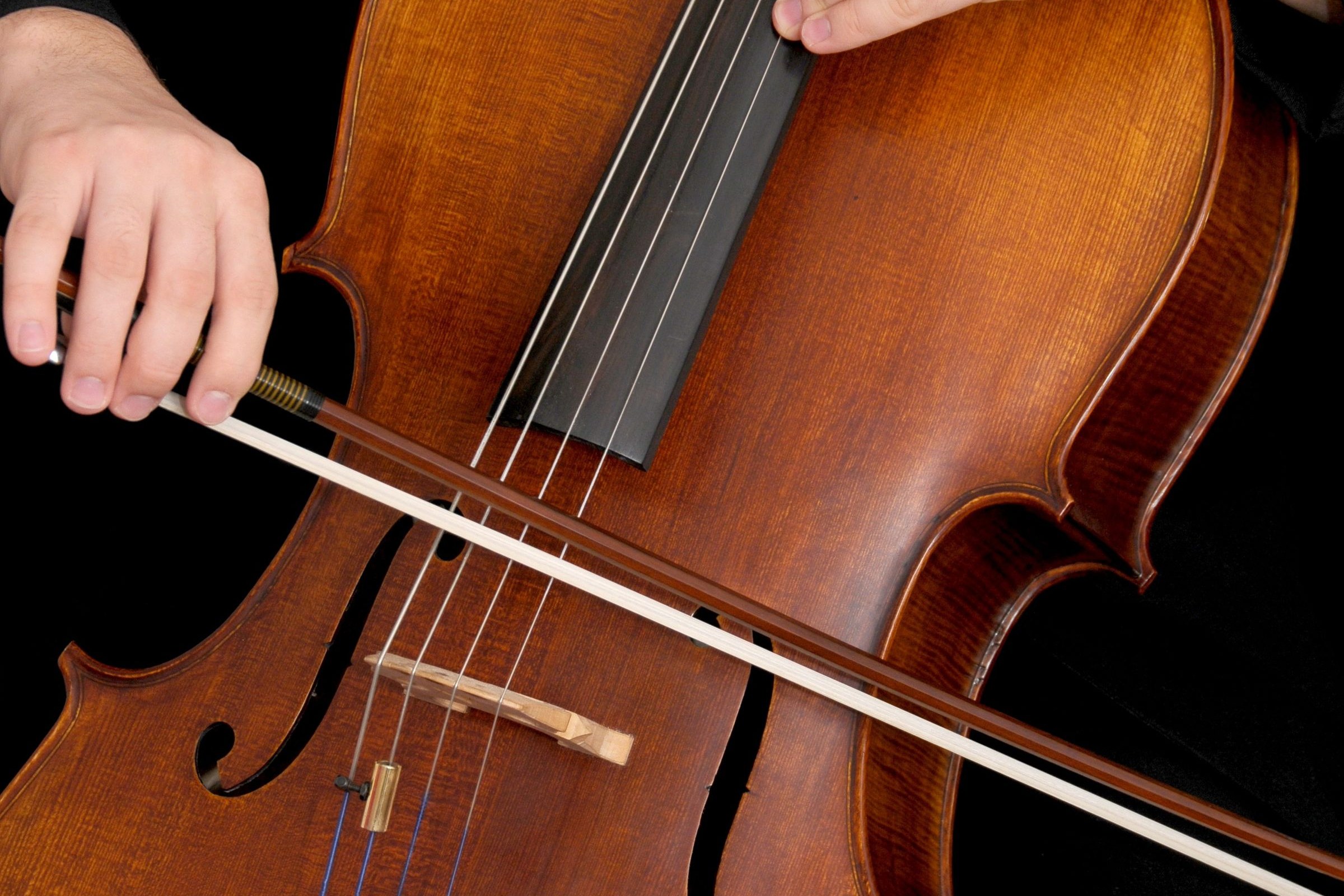
The work has four movements, and the first begins Adagio–Moderato. Instead of waiting for a long orchestral stage to be set, as in many concertos, the cello plays four decisive chords in the opening bar. Strings, clarinet and horn answer quietly.
On a first hearing, listen less to the force of those chords than to the silence after them. When the solo cello closes a sentence, the orchestra takes over the space and the viola introduces the theme. From the outset, the work unfolds less as a contest between soloist and orchestra than as a memory moving among different voices.
Movement 1 draws its tension from return, not simply speed
As the first theme passes from viola to cello, the same melody changes register and instrumental colour. Separate the cello's ascent into its high register from the return of the calm opening theme, and movement 1 reveals itself as more than the repetition of a single mood.
When listening to du Pré's recording, follow how far a whole phrase travels rather than measuring the force of one short note. Before judging bow pressure or vibrato, decide where the musical sentence arrives; this makes the performer's choice of a long line easier to compare.
Four movements illuminate the same memory at different speeds
The work moves through four movements: Adagio–Moderato, Lento–Allegro molto, Adagio, and Allegro–Moderato–Allegro ma non troppo. Use the quick figures in movement 2, the long solo line in movement 3 and the return of earlier material in the finale as listening signposts.
There is no need to analyse everything at once. On a first hearing, it is enough to remember the progression as ‘weight–motion–long song–forward movement and recollection’. When the ending recalls the work's beginning, the journey of nearly thirty minutes can feel as though it closes one great sentence.
Barbirolli and the London Symphony Orchestra's memory of the work
As a young cellist in 1919, Barbirolli played as a member of the London Symphony Orchestra at the concerto's premiere. 46 years later, he conducted the same orchestra in this recording with du Pré. The composer's premiere and the 1965 recording were thus connected within one performer's career.
That history adds the context of a conductor who had worked with the concerto's long span on the stage itself. Listen to how lightly the orchestra recedes when the cello comes forward, and how the ensemble recovers its weight when the cello falls silent.
How to remember one classical work long after a meal
Classical music does not become approachable only after every piece of background has been memorised. Hold on to one scene that stays in the ear—the opening four chords, the viola's theme or the final recollection—and the next hearing changes. This 1965 recording has long been loved. In the music itself, discover the moments exchanged between cello and orchestra one by one.
Mahina Vegan Table plays classical music in its dining space, while the journal continues to offer ways into the music itself. We introduce works and performers slowly, allowing them to linger like the memory of a meal and helping a new detail emerge the next time the same music returns.
Four questions for hearing the 1965 recording more clearly
- How old was Jacqueline du Pré when she made the recording?
- She was twenty at the time of the 1965 recording.
- How many movements does Elgar's Cello Concerto have?
- Four. Rather than simply alternating fast and slow movements, the concerto carries recollections of earlier material through to the end.
- Must I listen to the whole work from the beginning?
- No. Begin with the opening of movement 1 and the theme introduced by the viola; once they are familiar, continue into movements 2, 3 and 4.
- Is this recording the only definitive interpretation?
- No. It is an important historical recording, but comparison with other performances makes the possible range of tempo, bow pressure and orchestral balance easier to hear.
Classical music plays during meals at Mahina Vegan Table.
Plan Your Visit to Mahina Vegan Table